I am a Senior Economist at the Central Bank of Chile. I received my PhD in Economics from the University of Pennsylvania, and my MA in Economics and BA in Business and Economics from the Pontificia Universidad Católica de Chile. My research uses structural life-cycle models to study how families make decisions about fertility, education, and intergenerational transfers, and what those decisions imply for inequality and the macroeconomy. I also study oil shocks and production networks in the Chilean economy, labor market power, and how access to financing, such as factoring, affects firm dynamics and the transmission of monetary policy.
Research interests: family economics, fertility, human capital, macroeconomics, labor economics.
Macroeconomics and Labor Markets
How do oil shocks spread through input–output linkages in a small open economy, and what does this mean for monetary policy?
Abstract
We study how oil price shocks propagate across sectors in a small open economy and what this implies for monetary policy. Using Chilean data, with oil supply news shocks as instruments, we estimate how consumer prices respond to oil price shocks and separate the pass-through of oil costs that sectors pay directly from that of oil costs embedded in their intermediate inputs. We then estimate a twelve-sector New Keynesian model of Chile with the national input–output structure, in which households also buy fuel directly and a stabilization mechanism (MEPCO) smooths retail fuel prices. The model separates the amplification that comes from intermediate input intensity from the amplification that comes from inter-sectoral linkages. Finally, we study the optimal monetary policy response to the shock.
How much of the relationship between employer concentration and earnings reflects labor market power?
Abstract
We study how employment concentration in local labor markets relates to firm pay in Chilean matched employer–employee data for 2005–2019. Local labor markets are constructed from job-to-job flows using hierarchical agglomerative clustering, and concentration is instrumented with the leave-one-out mean of the log inverse number of employers in the same sector in other locations. We decompose the earnings–concentration coefficient exactly into worker composition, the marginal product of labor, and wage markdowns, to assess how much of the relationship reflects labor market power.

Does factoring mitigate or amplify the contraction in bank credit that follows a monetary tightening?
Abstract
We document that factoring—the sale of invoices for immediate cash—is an important source of short-term financing for Chilean firms, especially small ones. Whether factoring mitigates or amplifies the contraction in bank credit that follows a monetary tightening is an open question for policymakers. We study it by estimating local projections of the prices and quantities of bank credit and factoring on monetary policy surprises. We use two transaction-level administrative datasets for 2016–2024: bank loan originations from the Financial Market Commission (CMF), Chile’s financial regulator, which report the interest rate, amount, and maturity of each new loan, and assigned invoices from the Internal Revenue Service (SII), which report the seller, the buyer, and the assignee of each invoice. Because small and large firms differ in their access to bank credit and their use of factoring, we expect their responses to differ, and we estimate the local projections separately by firm size.
Family and Fertility
Why do first births come so much earlier for low-ability women? A life-cycle model in which cognitive ability shifts how reliably contraception is used, not just opportunity costs.
Abstract
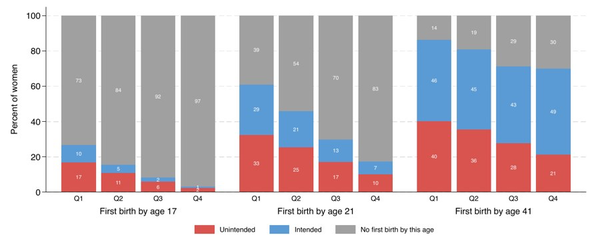
Among U.S. women born 1957–64, 63% of the lowest cognitive-skill quartile give birth before 22, against 18% of the highest. The gap is in unintended births, opens in high school, survives family background. In a life-cycle model where skills shift adherence—reliability of use—beyond wages and schooling, common adherence is rejected: it fits neither first-birth timing by skill nor within-method failure. Equalizing adherence cuts births by 21 by 16%, mostly for low-skill women; removing contraception’s cost does nearly as much, but its gains go to the high-skilled. Adding a long-acting method matches the fall in births Colorado’s program achieved.
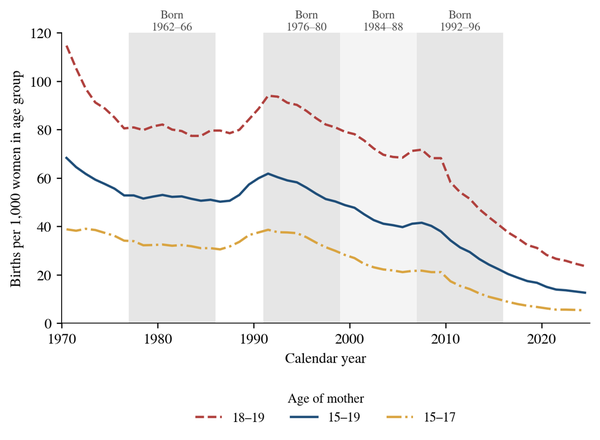
Fertility control accounts for 56 percent of the fall in births at 15–19 between the cohorts born in 1976–80 and 1992–96, better earnings and schooling prospects for 25 percent, and better-educated mothers for 12 percent. The early births it removed were unintended and were not had later.
Abstract
The U.S. teen birth rate has fallen by 80 percent since 1991, and lower birth rates before age 20 account for more than half of the fall in total fertility over the same period. By birth cohort, early first births rose before they fell: 31 percent of women born in 1962–1966 had a first birth by age 21, 33 percent of those born in 1976–1980 and 23 percent of those born in 1992–1996. To find which forces lie behind both movements, I estimate a life-cycle model of schooling, work, marriage and contraceptive use on three cohorts of women and decompose the change in early childbearing into the value of avoiding a birth, the cost and efficacy of contraception, exposure, abortion, the marriage market, the safety net and family background. Less sexual activity, more effective methods and a lower cost of contraception account for 56 percent of the fall in births at ages 15–19 between women born in 1976–80 and 1992–96 (25, 14 and 17 percent), better earnings and schooling prospects for 25 percent, and better-educated mothers for 12 percent. The early births that better fertility control removed were unintended and were not had later: completed fertility falls by 0.25 births per woman, about twice the reduction in early births. The part of the decline due to fertility control was a fall in completed fertility, not a postponement.
Education and Human Capital
Why does college discipline parental support? A dynastic model in which altruistic parents cannot commit to withholding transfers.
Abstract
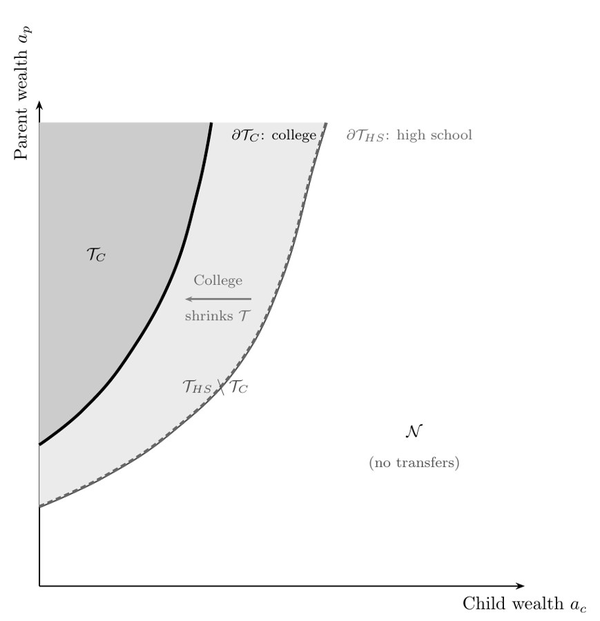
I study how parental altruism shapes investment in college. Altruistic parents support children when resources are low, financing college and insuring income risk but—because they cannot commit to withholding support—creating a Samaritan’s dilemma. College disciplines it where cash cannot, by permanently raising the child’s income. In matched parent–child data, parents of college children consume about 8% more (roughly $2,500 a year) yet transfer about a fifth less often—the signature of releasing the precautionary resources held to stand ready to help. I quantify the mechanism in a continuous-time dynastic model estimated by simulated method of moments. The inability to commit distorts the college decision unevenly: it raises attendance for low-ability children (by 13–18 percentage points), for whom anticipated support makes college affordable, but lowers it for the medium- and high-ability (by up to 27 points), who can lean on the parent’s lifetime safety net instead of investing to become self-sufficient—a small net decline. The same transfers that distort the college margin also insure children, so severing the relationship to remove the dilemma—through a one-time transfer—lowers welfare for both parent and child, about 12% for the dynasty; only full commitment, which removes the dilemma while preserving insurance, raises dynastic welfare (+15%), and it does so by reallocating from child to parent rather than as a Pareto improvement. Free college operates through the same relationship: it reallocates resources to the child (about +5%) rather than financing many new entrants, leaving the dynasty roughly neutral.
What are the general equilibrium effects of high-ability individuals ending up with low educational attainment in Chile?
Abstract
We analyze the general equilibrium effects of human capital misallocation in Chile. First, we utilize tax and educational records to estimate the proportion of educationally mismatched individuals (high-ability individuals with low educational attainment). Second, we estimate the labor market returns on ability, education, and human capital investment. Finally, we construct and calibrate a dynastic overlapping generations model with both private and public human capital investment to decompose the causes of educational mismatch and the general equilibrium effects of changes in sorting.
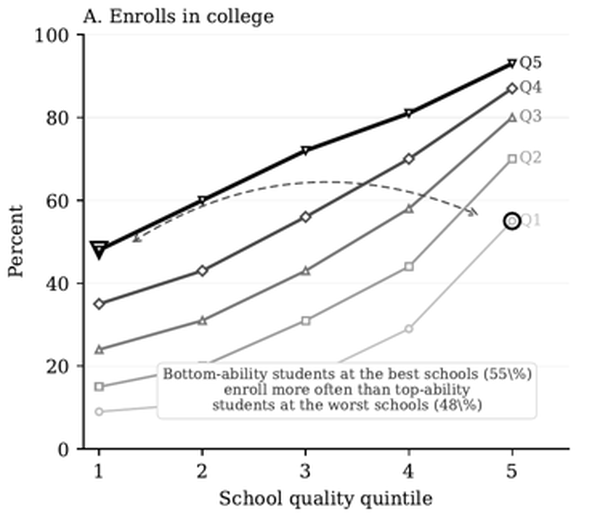
Why don’t selective universities expand, and how do the returns to degrees differ by program quality?
Abstract
Why do selective universities not expand their number of slots, and how do the returns to degrees differ by program quality? Using Chilean administrative data on university admissions, enrollment, and earnings, we estimate the returns to crossing admission cutoffs and how they depend on the quality gap to the student’s next-best option, and the effect of program capacity on students who are not at the margin. We then build a general-equilibrium model of major choice in which expanding or discouraging majors moves wages for everyone, to study the benefit of an additional slot that schools do not internalize.
Policy Papers
We estimate the U.S. federal fiscal imbalance at $202.9 trillion in perpetuity using Penn Wharton Budget Model microsimulations.
Abstract
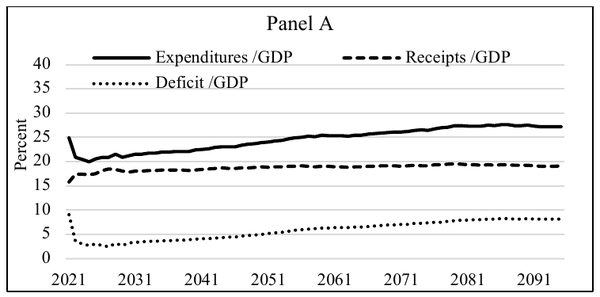
We use the Penn Wharton Budget Model’s microsimulation of U.S. demographics projections to construct estimates of the U.S. federal fiscal and generational imbalances. The federal government’s fiscal imbalance (FI) calculated under current fiscal laws and purchases policies over the next 75 years equals $93.8 trillion, which is 7.0 percent of the present value of projected GDP (PVGDP) over that time horizon. Calculated in perpetuity, FI equals $202.9 trillion, which is 8.2 percent of PVGDP, also calculated in perpetuity. The FI/PVGDP ratio in perpetuity would be 9.4 percent under extension of provisions that are scheduled to expire under the Tax Cuts and Jobs Act of 2017.
Pre-PhD Publication
Abstract
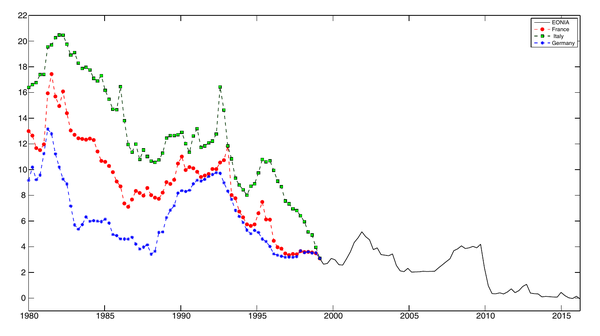
We find that, after the adoption of the euro, the European Central Bank has followed a forward-looking Taylor rule. This rule is such that nominal as well as real short-term interest rates increase in response to higher expected inflation or decline in output. Our findings show that the European Central Bank policy responses are of the same magnitude and sign as the ones prevailing in the pre-euro era for Germany, France, and Italy. We conclude that, before and after the euro, central banks in Europe have adopted a proactive stance towards controlling inflation.